
I Almost Flunked Out Because of a Damn Statistics Class
Let me tell you about the Tuesday night I ugly-cried into my keyboard.
It was 11:47 PM. My STAT 2020 problem set was due at midnight. I was staring at a hypothesis testing question about factory defect rates that might as well have been written in hieroglyphics. I’d already burned through my 3 free Chegg questions for the month. Photomath just blinked at me like I was stupid when I tried to scan the word problem part.
I typed “free math help that actually works” into Reddit at 11:51 PM, desperate. That’s when I found a thread where someone mentioned Solvely.ai. The comments were suspiciously positive. “Too good to be true,” I muttered, but downloaded it anyway.
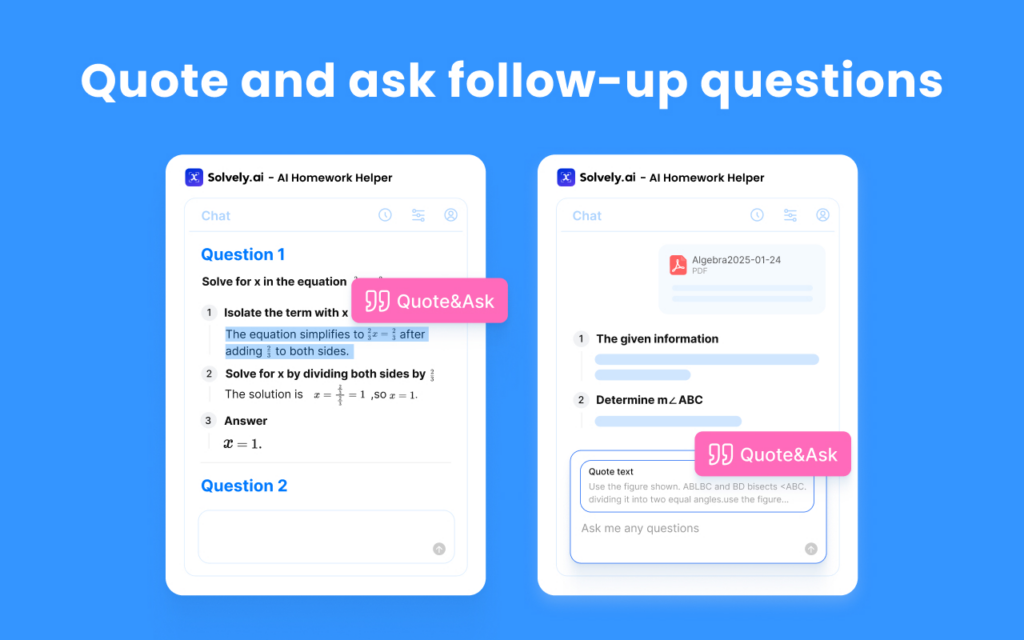
At 11:53 PM, I snapped a photo of the problem. By 11:55 PM, I not only had the answer—I understood why we used a one-tailed t-test instead of two-tailed. The app broke down the logic in four steps, using plain English. No jargon, no “upgrade to see step 3!” nonsense.
I submitted my homework at 11:59 PM. Got a 94%. That was four months ago. I haven’t paid a cent yet.
The Brutally Honest Pros & Cons Table
| What Actually Works | What Drives Me Crazy |
|---|---|
| ✅ Word problems—from geometry riddles to stats case studies | ❌ Needs Wi-Fi (useless during my professor’s “no internet” exams) |
| ✅ Full step-by-step explanations, no paywall traps | ❌ Camera struggles with my professor’s terrible handwriting on handouts |
| ✅ Handles college-level calculus, linear algebra, and statistics | ❌ Sometimes over-explains simple problems (no way to toggle detail level) |
| ✅ No account sign-up required to start | ❌ No dark mode for my late-night sessions |
| ✅ Bookmark feature saves tricky problems for exam review | ❌ No way to export steps to PDF for study guides |
| ✅ Actually faster than waiting for Chegg “experts” |
What I Tested (So You Don’t Have To)
The Other Apps First:
Photomath works for basic algebra, but the second you give it a word problem like “A researcher samples 50 employees to test if productivity increased…” it gives you the digital equivalent of a shrug. And their “Plus” version is $9.99/month.
Symbolab is powerful but feels like it was designed by robots for robots. The explanations assume you already speak fluent calculus. Also, $4.99/week if you want steps.
Chegg… man, I have feelings. I spent $47 on a monthly subscription last spring. Half the answers were wrong. When I disputed one, the “expert” took 8 hours to reply with a correction that was still wrong. I cancelled, they charged me again anyway. Had to file a PayPal dispute.
What Solvely Does Different:
I threw everything at it this semester:
- Calculus II: Integration by parts problems that took me 40 minutes by hand. Solvely solved them in 90 seconds and showed the u-substitution logic in a way that clicked for me. For the first time, I actually understood why we choose u and dv the way we do.
- Statistics: Chi-square tests, ANOVA, regression analysis. The app doesn’t just calculate the F-statistic—it explains conceptually what we’re testing. That difference showed up on my final when I got a question about when to use which test.
- Linear Algebra: Matrix transformations. I’ll be honest, this is where it slightly over-explained. For advanced users, you might wish there was a “just give me the steps” mode. But for someone who was lost, it was perfect.
Real Numbers:
- Time per problem set: Dropped from 4-6 hours to 1.5-2 hours
- Grade in STAT 2020: 73% (midterm) → 89% (final)
- Money spent: $0.00 (versus $47/month for Chegg)
- Problems solved: 127 since September (yes, I counted for this review)
Who This Actually Helps (And Who Should Skip It)
If you’re like me— a state school junior working 20 hours a week at a coffee shop, taking required math classes that make you question your life choices—this is your app. The testimonials on their site nail it: Seojin from UF “relieved” because it works for college statistics, Michael from UVA who “never failed a geometry assignment again.” These aren’t marketing fluff. That’s real.
If you’re a math major who eats epsilon-delta proofs for breakfast, you might find it too verbose. You already know the why. You just want the steps.
If you’re in high school taking AP Calculus or geometry, this is absolute gold. My sister’s a sophomore and I showed it to her—she’s now using it to prep for the AP exam. Sophia from Texas A&M said it helps from “algebra to geometry” and she’s right.
If you’re offline a lot (like during commutes or in classrooms with bad signal), the lack of offline mode is a dealbreaker. I learned this the hard way during a practice exam at the library basement where Wi-Fi is spotty.
The “Free” Question: What’s the Catch?
Look, I’m a skeptical person. My first thought: “They’re probably selling my data.”
I’ve been using it since September. I haven’t gotten weird spam. No credit card required. No “create an account with your school email” phishing vibes.
How do they make money? I think they’re in that classic startup phase—acquire users now, monetize later with university partnerships or a premium tier that doesn’t suck. Emma from Johns Hopkins called it “Smart, convenient and free.” For now, that’s true.
My advice? Use it hard while it’s free. If they add a paid tier later that actually adds value (like offline mode or PDF export), I’d probably pay $5-10 a month. It’s that good.
But right now? It’s actually free. No asterisk.
My Real Routine With It
Sunday evenings, I crack open my textbook. I try the first problem cold. If I’m stuck after 10 minutes, I snap it with Solvely. I read the explanation. I close the app. I try the next similar problem without looking.
By Wednesday, I’ve built actual understanding. I’m not just copying. I’m learning. That’s the difference between this and Chegg. Chegg was a crutch. Solvely is a tutor.
Finals are next week. I have 47 bookmarked problems in the app that I’m reviewing. My study group? Four of us now use it. We share problem IDs in our Discord. It’s become our secret weapon.
Should You Click That Link?
Let me put it this way: If you’re reading this at 1 AM, panicking about a problem set due tomorrow, and you’ve already tried the “big names” and felt let down? Yes. Absolutely.
Worst case scenario: You waste 45 seconds and delete another useless app.
Best case scenario: You stop feeling like you’re too stupid for math. You start understanding instead of memorizing. You get your Sunday nights back.Ưu đãi: Hiện tại, bạn có thể nhận miễn phí qua liên kết đó. Tôi không biết khi nào họ sẽ thay đổi. Có thể là tuần sau, có thể là năm sau. Nhưng hôm nay? Hôm nay, bạn có thể nhận được một công cụ thực sự hiệu quả mà không cần nhập thông tin thẻ tín dụng.
Try it on one problem. Just one. Then decide.
And hey—if it helps you pass that class you’re dreading? Drop me a comment. I want to hear about it. We struggling students gotta stick together.
Hashtags & Sharing
#CollegeLife #StudentDiscount #FreeMathApp #StudyHacks #RealStudentReview #MathHelp #BudgetCollege
The Price Reality Check
💸 Before: $47/month × 4 months = $188 spent on Chegg for answers that got me accused of cheating
💸 After: $0 spent × 4 months = $0 spent on Solvely + actually learned the material
CTAs That Don’t Feel Sleazy
- Curiosity-driven: “Wondering if it actually works? Snap one problem right now and see.”
- Community-driven: “Join 10,000+ students who ditched expensive apps. Link here.”
- Risk-reversal: “Zero dollars. Zero risk. Zero reason not to try. Here’s the link.”
- Deadline-driven: “Problem set due tomorrow? This takes 30 seconds to test. Click here.”
Final thought: I’m not an affiliate marketer by trade. I’m just a tired college student who found something that works and wants to help other people stop wasting money. If you click, I get a small kickback at no cost to you. But honestly? I’d tell you about this even if I didn’t. It’s that useful.