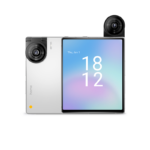

I’ll be honest: when I first saw the MindOne Pro, I rolled my eyes. Another “AI phone” pitch from a company that makes DACs and earbuds. But after digging into what this thing actually is, I’ve come around. This isn’t just another smartphone with a ChatGPT shortcut baked in. It’s a genuinely different device that solves a real problem for a specific kind of user, and at $429, it’s priced like an experiment worth taking.
The MindOne Pro is available for pre-order now with deliveries starting July 2026.
Pros & Cons
| ✅ Pros | ❌ Cons |
|---|---|
| Truly pocketable credit card size at 8.9mm thin and 136g | Small 2200mAh battery won’t replace your main phone |
| Built-in free AI internet in 60+ countries with no SIM needed | MediaTek MT8781 is mid-range, not flagship performance |
| 50MP Sony camera with 180° flip and OIS | Pre-order only, deliveries start July 2026 |
| AMOLED display with 90Hz, Sapphire Glass, and DC Dimming | Accessories like the Snap-in Case and Lanyard Case are sold separately |
| 8GB RAM + 256GB storage, Android with AI-focused OS | iKKO is an audio brand, not a phone company; long-term support is uncertain |
What Is the MindOne Pro?
The MindOne Pro is a credit card-sized smartphone built by iKKO, a company better known for portable DACs and in-ear monitors than phones. It runs a custom version of Android 15 called iKKO AI OS, ships with built-in AI tools, and includes free global internet connectivity in over 60 regions without needing a physical SIM card.
That last part is what makes this interesting. The device has a vSIM that connects to AI internet services for free, letting you use ChatGPT, translation tools, and other AI features anywhere without paying for roaming or hunting for WiFi. You can still pop in your own nano SIM for full-speed data when you want it, but the baseline connectivity is baked into the purchase price.
The screen is an AMOLED panel at 1240×1080 resolution with a 90Hz refresh rate, covered by 9H Sapphire Glass on the Pro model. It’s not an iPhone competitor and it’s not trying to be one. Think of it as a secondary device that handles AI tasks, quick photos, and light browsing without dragging your main phone out of your pocket.

Size That Actually Changes How You Use It
At 8.9mm thick and 136 grams, the MindOne Pro disappears into a shirt pocket or the side of a wallet. Compare that to an iPhone 16 Pro at 199 grams and you start to see the appeal. This isn’t about having a “small phone” in the iPhone Mini sense. It’s about having a device so unobtrusive that you forget you’re carrying it until you need it.
The Sapphire Glass display is a nice touch at this price point. You usually see that on watches or $1,000-plus phones, not on a $429 device from an audio brand. Combined with DC Dimming to reduce PWM flicker, the screen punches above its weight class for readability and eye comfort.
I think the real use case here is a travel companion or a “focus mode” device. Leave your main phone in your bag and carry this for maps, AI queries, quick photos, and messaging. It does enough to keep you connected without the doom-scrolling temptation of a full-sized screen.
AI OS and Free Global Internet
The AI OS layer is where iKKO is taking a swing. Instead of bolting AI features onto stock Android, they’ve built the OS around them. There’s a Focus Mode that surfaces AI tools contextually rather than making you dig through apps. The built-in vSIM connects to AI internet service across Europe, parts of Asia, and North America.
This is the feature that separates the MindOne Pro from every other small Android phone on the market. You land in a new country and the device already has connectivity for AI services. No eSIM setup, no airport WiFi login page, no international data plan. It just works for the things you actually need AI for: translation, navigation queries, restaurant recommendations, quick research.
That said, the MediaTek MT8781 processor is a mid-range chip. It has two Cortex-A76 cores at 2.2GHz and six A55 cores at 2.0GHz. This isn’t going to run local LLMs or process 4K video. For cloud-based AI queries and everyday tasks it’s fine, but anyone expecting flagship performance will be disappointed.

A 50MP Flip Camera That Punches Above Its Weight
The 50MP Sony sensor with a 180-degree rotating mechanism is clever. You get the same sensor for both rear shooting and selfies, which means your video calls and self-portraits benefit from a proper 1/1.56-inch sensor with OIS and an f/1.88 aperture instead of the tiny front-facing sensors most phones use.
Video tops out at 1440p at 30fps with H.265 encoding. Not cinematic, but perfectly usable for video calls, social clips, and quick documentation. The flip mechanism also means you can position the camera at angles that are awkward or impossible with a fixed-lens phone, which opens up some creative shooting options.
The OIS is welcome at this price. Cheap small phones usually skip stabilization entirely, so getting optical stabilization on a 50MP sensor in a credit-card form factor is genuinely impressive.
What’s the Trade-Off?
The 2200mAh battery is small by any standard. iKKO claims up to 16 hours of video playback, but that’s almost certainly under ideal conditions with WiFi off and brightness low. In real-world use with the AI internet connection active and the screen at a comfortable brightness, you’re probably looking at a day of light use or an afternoon of heavier use.
The Snap-in Case accessory, which adds a Hi-Fi DAC and a physical QWERTY keyboard, is sold separately at $89. The Lanyard Case costs another $20. These feel less like optional accessories and more like essential parts of the experience that should have been included or at least bundled at a discount.
And then there’s the company itself. iKKO has no track record with phones. Their expertise is in audio hardware, not software updates or mobile OS support. If you’re buying a phone that runs a custom Android fork, you’re betting on the company’s ability to ship security patches and OS updates for years. That’s unclear with iKKO.

Who Should Buy It?
The MindOne Pro is for people who travel frequently and want a secondary device that handles AI, photos, and light communication without the bulk of a full phone. It’s also for anyone curious about the “AI-first device” concept who doesn’t want to spend $700 on a Rabbit R1 or Humane Ai Pin that does half as much.
If you’re looking for a primary phone replacement, this isn’t it. The battery is too small, the processor is too modest, and the software ecosystem is too uncertain. But as a companion device that gives you AI connectivity anywhere in the world with a proper camera and a beautiful screen, it makes a surprising amount of sense at $429.
🛒 Where to Buy
Heads up: this is an affiliate link and I may earn a commission at no extra cost to you.
The Bottom Line
The MindOne Pro is the most practical take on the “AI device” concept I’ve seen yet. It doesn’t try to replace your phone or convince you that AI needs a dedicated piece of hardware. It just takes a small Android phone, strips away the parts you don’t need in a secondary device, and adds genuinely useful features like free global AI internet and a flip camera.
At $429, it’s priced like a mid-range smartwatch but does far more. The battery life and the company’s lack of phone experience are real concerns, and anyone treating this as a main device is setting themselves up for frustration. But as a travel companion or a focused AI tool that fits in a credit card slot? It’s the first device in this category that doesn’t feel like a solution in search of a problem.
Check out the MindOne Pro on iKKO’s store →