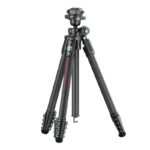

Most travel tripods force you to choose: lightweight but flimsy, or sturdy but a pain to carry. The Ulanzi JJ05 GlideGo doesn’t make you pick. It’s a carbon fiber tripod that folds down to 18.5 inches, extends past 54 inches, and brings a genuinely useful quick-release system that had me rethinking my entire mounting setup.
Pros & Cons
| ✅ Pros | ❌ Cons |
|---|---|
| Carbon fiber, 5-section design packs small without sacrificing stability | $249 puts it in a competitive bracket |
| Uka quick-release is a real Arca-Swiss upgrade — no twist knobs | Proprietary plates mean buying spares isn’t as cheap as standard Arca |
| Two-stage center column tilts horizontal for flat-lay and overhead work | Ball head friction isn’t as granular as premium fluid heads |
| Folded length of 18.5″ fits in most daypacks and carry-on luggage | Leg angle locks feel a bit stiff out of the box |
What Is the Ulanzi JJ05 GlideGo?
The JJ05 is Ulanzi’s travel-focused tripod in their new GlideGo series. Launched alongside the video-optimized JJ06, the JJ05 leans toward hybrid shooters — people who bounce between photo and video and don’t want to carry two support systems.
It’s built around a 5-section carbon fiber leg set with machined aluminum joint locks. At 18.5 inches folded and roughly 2.8 pounds, it’s not the absolute lightest tripod on the market, but it’s firmly in the “throw it in your bag and forget about it” category. The build quality, especially at this price, punches noticeably above what I expected from a brand better known for LED lights and phone cages.
The standout feature — and the thing that separates this from a dozen other carbon fiber travel tripods — is the Uka quick-release system. It’s Ulanzi’s take on Arca-Swiss, redesigned to drop in from the top instead of sliding in from the side. If you’ve ever fumbled with aligning an Arca plate while balancing a camera in the other hand, this alone might sell you on it.

Uka Quick-Release: The Feature That Changes Everything
I’ve used Arca-Swiss for years. It’s the industry standard for a reason — but the sliding-plate design has always been the weak link. You have to loosen a knob, slide the plate out sideways, align it again when remounting, and hope you didn’t bump the framing in the process.
Uka flips the script. The plate drops in vertically and locks with an audible click. Releasing it is a one-handed squeeze of a lever on the side of the head. No knobs to twist, no alignment guesswork. I was skeptical at first — “just another proprietary system” — but after using it for a day, going back to standard Arca felt like stepping back a decade.
The catch: you’ll want spare Uka plates for every camera body and long lens you own. At about $15-20 per plate, that adds up. But if you’re already invested in Ulanzi’s F38 ecosystem (which is cross-compatible), you probably have plates lying around anyway.
Built for Hybrid Workflows
Here’s where the JJ05 earns its “video tripod” name despite having a photo-style ball head. The center column has two stages. The first raises and lowers normally. The second stage, unlocked by a separate knob, tilts the column all the way to horizontal. Want an overhead flat-lay? Done. Need a low-angle shot without inverting the head? Done. PetaPixel’s hands-on review called this out as a standout for product photographers and content creators who need versatility without lugging a C-stand.
The ball head itself is smooth, though not buttery. The panning base at the bottom is independent of the ball lock, which means you can level the head once and pan separately — a small touch that makes a big difference for video pans and real estate walkthroughs. The inverted ball head design also puts the quick-release plate closer to the tripod’s center of gravity compared to traditional ball heads, which helps with stability when shooting at extreme angles.

What Are the Trade-Offs?
At $249, the JJ05 sits in the same conversation as the Peak Design Travel Tripod ($380+) and the Benro Rhino series ($290+). It’s cheaper than both, but there are things you don’t get.
The leg angle locks — those metal clip mechanisms at each joint — are sturdy but not as refined as the twist locks on premium Manfrotto or Gitzo legs. They work, and they lock securely, but out of the box they have a mechanical stiffness that takes a few sessions to break in. If you’re the type who adjusts leg angles mid-shoot, you’ll notice this.
The ball head’s friction control is also a single adjustment — there’s no separate drag setting for precise tilt control the way dedicated video heads offer. For photography, it’s fine. For video pans where you want consistent resistance, you’ll want the JJ06’s fluid head instead. That’s not a flaw so much as a choice: the JJ05 is a photo-first hybrid, not a video-first rig pretending to do both.
Weight-wise, at 2.8 pounds it’s well within travel territory. Compare that to the Peak Design at 2.8 lb or the 3.1 lb Benro Rhino, and the JJ05 holds its own. The carbon fiber dampens vibrations well — better than the aluminum alternatives in the $150-200 range — which matters when you’re shooting long exposures or telephoto from a windy overlook.
Who Should Buy the Ulanzi JJ05?
If you’re a solo content creator who shoots photo and video on the same outing — think wedding photographers who also deliver highlight reels, product reviewers who need both stills and b-roll, or travel vloggers who don’t want a second bag just for support gear — the JJ05 is tailor-made for you. The quick-release alone saves enough setup time per shoot to justify the price within a month of regular use.
If you’re a pure videographer who never takes stills, skip this and look at the JJ06 or a dedicated video tripod with a proper fluid head. And if you already have a tripod you love and your current quick-release system works for you, the Uka upgrade might not be enough to warrant the switch. But if your current travel tripod frustrates you — too heavy, too fiddly, too slow to set up — the JJ05 is worth a hard look.

Where to Buy
(affiliate link, I may earn a commission at no extra cost)
The Bottom Line
The Ulanzi JJ05 GlideGo is the kind of tripod that makes you wonder why quick-release systems stayed stuck in the 1990s for so long. The Uka mechanism is genuinely better, the carbon fiber build is solid, and the two-stage tilting center column opens up creative angles that most travel tripods simply can’t reach.
It’s not the cheapest option at $249, and the proprietary plate ecosystem will add cost if you need extras. But for hybrid shooters who value speed and versatility — and who are tired of fighting their gear instead of using it — this is one of the most thoughtful travel tripods I’ve come across in years.