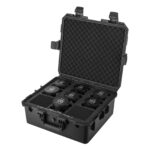

I’ve spent years watching filmmakers spend $12,000 on a set of three cine primes without blinking. So when I first picked up a Meike 50mm T2.1 — all-metal housing, smooth 270° focus throw, clickless aperture — and learned it cost $539, I honestly thought the price was a typo. Meike has been quietly building a full-frame cine lens ecosystem that competes with glass costing 3-4x more, and after putting their 35mm, 50mm, and 85mm through their paces, I’m convinced this is the best value in cinema glass right now.
Browse Meike’s full FF Prime Cine lineup here — the 35mm, 50mm, and 85mm T2.1 are the ones to start with.
Pros & Cons
| ✅ Pros | ❌ Cons |
|---|---|
| Full-frame cine primes for $400-540 each | No weather sealing |
| All-metal construction with standardized 0.8 MOD gear rings | T2.1 max aperture — no T1.4/T1.5 option |
| 270° focus rotation — plenty of room for follow focus | Lens markings vary slightly between copies |
| Interchangeable mounts: PL, EF, E, RF (swappable with shims) | Manual focus only (standard for cine, but worth noting) |
| Available from 16mm to 135mm in T2.1/T2.4 | Some CA wide open on the wider focal lengths |
| Color-matched across the set — cut between lenses without regrading | Resale value unknown — you’re not buying Zeiss |
What Makes These Different
Most “affordable” cinema lenses cut corners where it hurts: plastic housings that flex under a follow focus motor, inconsistent gear ring positions, and optical quality that falls apart at the edges. Meike went the other direction entirely. Every FF Prime lens has an all-metal body, standardized 0.8 MOD gear rings at the same position across focal lengths, and a 270-degree focus rotation that gives your AC actual breathing room to nail a pull.

I mounted the 50mm on a Sony FX3 rig and the weight immediately felt reassuring — not heavy enough to need lens support, but dense enough that a Nucleus Nano follow focus didn’t feel like it was grinding plastic gears. The clickless aperture ring is buttery smooth with just enough resistance to prevent accidental bumps. What surprised me most was the mount system: Meike sells swappable PL, EF, E, and RF mounts with shims, so you’re not locked into one ecosystem. Buy once, adapt later.
Image Quality: The 50mm Is the Standout
At T2.8, the 50mm T2.1 is genuinely sharp across the frame — I’d put it against lenses costing $1,500-2,000 without hesitation. Contrast is good, falloff feels organic rather than clinical, and there’s a slight warmth that flatters skin tones. The 85mm T2.1 is nearly as impressive: tight headroom, beautiful background separation, and minimal breathing when pulling focus.
The 35mm is where you see a bit of character. Wide open at T2.1, there’s some purple fringing at the edges and the corners soften noticeably. Stop down to T2.8 and it cleans up nicely, but if you’re shooting wide-open narrative work, know that the 35mm has more “personality” than the longer focal lengths. Whether that’s a bug or a feature depends on your project.

One thing reviewers rarely mention: the color rendering across the set is remarkably consistent. Cutting between the 35mm and 85mm doesn’t require a full grade correction, which is more than I can say for some vintage lens sets I’ve frankensteined together from eBay. If you’re buying a set, get them from the same batch — Meike’s production consistency within a single run is solid.
The Full Lineup (And What to Buy First)
Meike’s FF Prime line covers 16mm T2.5, 24mm T2.1, 35mm T2.1, 50mm T2.1, 85mm T2.1, 105mm T2.1, and 135mm T2.4. Pricing runs roughly $400-540 per lens, with kits of 3, 4, 5, or 7 lenses available at bundle discounts. For most shooters, the sweet spot is the 35mm + 50mm + 85mm trio — that covers 90% of interview, narrative, and commercial work.
If I had to pick one to start with, it’s the 50mm T2.1. It’s the most optically refined of the set and the focal length you’ll reach for most. Add the 85mm next for interviews and close-ups, then the 35mm when you need wides.

Who Should Buy (And Who Shouldn’t)
These lenses are built for filmmakers who’ve outgrown adapted stills glass but can’t justify $3,000+ per lens for Zeiss CP.3 or Canon CN-E primes. If you’re shooting music videos, short films, wedding films, or corporate interviews on a mirrorless body (Sony FX3/FX6, Canon C70, RED Komodo, Blackmagic), the Meike FF Primes give you 85% of the high-end cine lens experience for about 20% of the price.
Who should skip: if you shoot in rain, dust, or unpredictable conditions regularly, the lack of weather sealing is a legitimate dealbreaker. If you need T1.4 or faster for available-light narrative work, these cap out at T2.1 (and the 135mm at T2.4). And if client perception matters — if showing up with “Zeiss” or “Arri” on the lens barrel is part of your booking pitch — these won’t scratch that itch. But for everyone else, the 50mm T2.1 at $539 is the best entry point into proper cine glass I’ve found in 2026.
Where to Buy
(affiliate link, I may earn a commission at no extra cost)
The Bottom Line
Meike’s FF Prime cine lenses are the kind of value proposition that makes you wonder what the big brands are charging for. Metal construction, smooth mechanics, interchangeable mounts, and image quality that holds its own against glass costing 3x more — all for under $550 per lens. The trade-offs are real (weather sealing, some CA wide open, no brand cachet) but at this price point, complaining about those feels petty.
If you’re still piecing together adapted vintage lenses with 3D-printed gear rings and praying your follow focus doesn’t skip, stop making your life harder than it needs to be. Grab the 50mm T2.1 first — see how a proper cine housing changes your workflow — and build the set from there. Your focus puller will thank you.