
Here’s a truth most scooter brands don’t want you to sit with: the gap between a €800 scooter and a €2,000 one has never been smaller. I’ve watched the electric scooter market inflate prices year after year, slapping “Pro” and “Ultra” labels on machines that don’t actually deliver twice the value. So when I dug into what the KuKirin G2 Master offers at €839, I wasn’t expecting much. Turns out I needed to recalibrate my expectations.
Pros & Cons
| ✅ Pros | ❌ Cons |
|---|---|
| Dual 1000W motors deliver genuine 60 km/h top speed | 70 km advertised range is under ideal conditions — real-world is closer to 45-50 km |
| Hydraulic suspension front and rear — rare at this price | At around 35 kg, it’s heavy to carry up stairs |
| 52V 20.8Ah battery with 21700 cells for solid longevity | 10-inch tires are fine for most terrain but 11-inch would handle deep potholes better |
| IP54 rating means it can handle rain and wet roads | No companion app or smart features — purely analog controls |
| €839 EU pricing undercuts most competitors by at least €300-400 | Brand recognition is still catching up to Segway and Xiaomi in some markets |
What Is the KuKirin G2 Master?
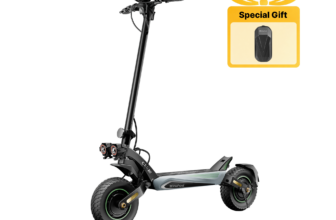
The G2 Master is Kugoo’s flagship all-terrain electric scooter, built around a dual-motor drivetrain that pushes 1000W through each wheel. That’s 2000W of peak output propelling a 35 kg frame — and yes, it feels exactly as quick as those numbers suggest.
Kugoo has been quietly manufacturing electric scooters out of China for years, mostly selling through their own direct-to-consumer site and Amazon storefronts across Europe. They’re not a startup trying to reinvent the wheel — they’re an OEM that decided to cut out the middleman and sell straight to riders. That’s a big reason the pricing looks the way it does.
The G2 Master sits at the top of their lineup. Below it you’ll find the G2 Pro, G3 Pro, and the more budget-minded S1 Max — but the Master is where Kugoo throws everything they’ve got at the spec sheet.

The Dual-Motor Setup Is the Real Story Here
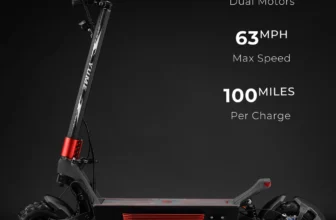
A lot of scooters in the €600-900 range advertise dual motors but deliver something closer to two underpowered hubs that barely keep up with each other. The G2 Master doesn’t play that game. Each 1000W motor gets its own controller, and the torque delivery is genuinely smooth — not jerky, not hesitant, just progressive power that builds with the throttle.
In dual-motor mode you’re hitting 60 km/h, which is fast enough to feel genuinely thrilling without crossing into “this feels like a terrible idea” territory. Single-motor mode limits you to the rear wheel only, which stretches the battery significantly if you’re just cruising. I appreciate that Kugoo didn’t try to gimmick this with a million ride modes — you get Eco, Turbo, and single/dual toggle, and that’s all you actually need.
The acceleration curve is tuned well too. Some budget dual-motor scooters launch like a startled horse, which sounds fun until you’re trying to navigate a crowded bike lane. The G2 Master’s throttle response is progressive enough that low-speed maneuvering doesn’t feel like you’re fighting the machine.

Hydraulic Suspension at This Price Is Almost Unfair
This is the feature that made me do a double-take when I was going through the spec sheet. Front and rear hydraulic shock absorbers are standard equipment you’d expect on scooters in the €1,200-1,500 range. The G2 Master includes them at €839.
The practical difference is night and day compared to spring-only setups. Cobblestone streets, uneven pavement, gravel paths — the suspension actually absorbs instead of transferring everything straight to your knees. The front fork has decent travel too, somewhere in the 115mm range based on the geometry, and the rear dual-shock setup keeps the deck stable even when one wheel hits something the other doesn’t.
Combined with the 10-inch pneumatic tires, the ride quality is comfortably above what I’d expect at this price point. You’re not getting motorcycle-level damping, but for an electric scooter, it’s genuinely impressive.
Range and Battery: Honest Numbers Matter
Kugoo advertises 70 km of range, which — as with every electric scooter ever made — assumes you weigh 60 kg, ride in Eco mode on flat ground, and have a tailwind sent by the scooter gods themselves. Real-world range in dual-motor mixed riding is closer to 45-50 km, which is still solid for a 52V 20.8Ah pack built around 21700 lithium cells.
Those 21700 cells matter. They’re the same cell format Tesla uses in the Model 3 and Model Y — higher energy density than the older 18650 cells, better heat management, and generally longer cycle life. For a scooter in this price bracket, getting a 21700-based pack instead of generic 18650s is a meaningful upgrade you’ll feel two years down the road when the battery still holds a decent charge.
Charging takes about 8-10 hours from empty with the included 2A charger. You can buy a faster charger separately, but honestly, most people charge overnight anyway so the stock unit is fine.

What’s the Trade-Off?
At 35 kg, this scooter is not light. If you live in a walk-up apartment, carrying it up three flights of stairs every day is going to get old fast. It folds down compactly enough to fit in a car trunk or a corner of a hallway, but “portable” and “portable for a 35 kg dual-motor scooter” are two different things.
The lack of a companion app or smart dashboard also feels like a missed opportunity in 2026. There’s no Bluetooth connectivity, no ride tracking, no digital lock — just a straightforward LED display showing speed, battery level, and mode. Some riders will prefer the simplicity. If you’re coming from a Segway or Xiaomi with app connectivity, it’ll feel bare-bones.
The 10-inch tires are also worth noting. They’re fine for most urban and light off-road riding, but if you regularly tackle deep potholes or seriously rough trails, 11-inch tires with a taller sidewall would give you more margin. That said, the hydraulic suspension does a lot of the work the tires don’t.
Who Should Buy the G2 Master?
This scooter is built for the rider who wants dual-motor performance and proper suspension without paying dual-motor-plus-suspension prices. If you commute 10-15 km each way on mixed terrain — some pavement, some gravel, maybe a park shortcut — the G2 Master hits a sweet spot that few competitors touch.
It’s also a great pick if you’re stepping up from a basic commuter scooter (the kind that tops out at 25 km/h and bottoms out on every curb) and want something that actually feels like a vehicle rather than a toy. The jump in stability, speed, and ride comfort is dramatic.
Who should skip it? Anyone who needs true portability — folding bikes and lightweight commuters exist for a reason. And if you’re riding exclusively on glass-smooth bike lanes at 25 km/h, you’re overpaying for horsepower you won’t use. But if that’s not you, keep reading.
🛒 Where to Buy
Heads up: this is an affiliate link and I may earn a commission at no extra cost to you.
The Bottom Line
The KuKirin G2 Master is one of those rare products where the value proposition is so clear you almost feel bad for the competition. Dual 1000W motors, full hydraulic suspension, a 52V 21700-cell battery, and genuine 60 km/h speed — all for €839. Three years ago that spec sheet would have cost you €1,500 minimum.
Is it perfect? No. It’s heavy, it’s analog, and the real-world range is shorter than the brochure suggests. But those compromises feel proportionate to the price, not like corners being cut. For anyone who wants a serious all-terrain scooter without financing it like a used car, the G2 Master is hard to beat right now.
Check out the G2 Master on Kugoo’s official store if you’re ready to see what dual-motor riding actually feels like.