

Most moped-style e-bikes look cooler than an actual moped but can’t back it up where it counts. You get the aggressive stance and fat tires, sure, but the battery dies halfway through a weekend adventure and the suspension bottoms out on anything rougher than a painted line. After spending time looking at what the M20 actually delivers versus what the spec sheet promises, I think ENGWE cracked something here that a lot of brands at this price point haven’t. The dual-battery setup on the M20 isn’t just a spec sheet flex – it’s the feature that transforms this from a neighborhood cruiser into something you could actually commute on.
Pros & Cons
| ✅ Pros | ❌ Cons |
|---|---|
| Dual-battery range up to 150km (93 miles) | Heavy at ~70 lbs, not easy to carry upstairs |
| Full suspension handles rough roads surprisingly well | Mechanical disc brakes, not hydraulic |
| 1000W peak motor pulls hard from a stop | Bench seat isn’t adjustable for different rider heights |
| Retro moped styling turns heads everywhere | Single-battery base model feels incomplete |
| Genuine value at $1,099-$1,299 | Shipping and assembly take a few hours |
What Is the ENGWE M20?
The M20 is ENGWE’s first crack at the moped-style e-bike category. They built their name on folding fat-tire commuters – practical, affordable, and honestly a little dorky-looking. The M20 is none of those last three things.
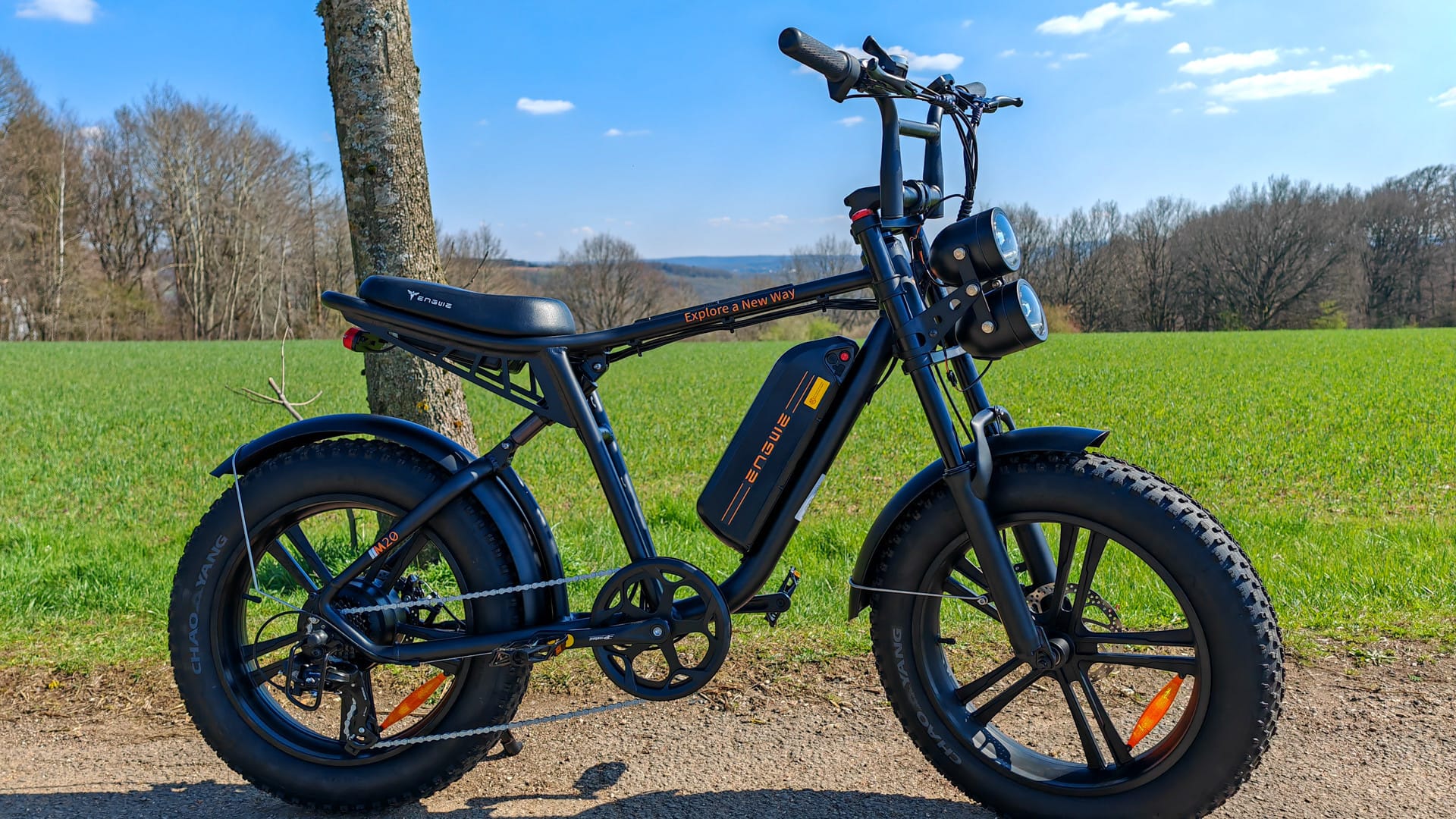
You get a 750W hub motor that peaks at 1000W, wrapped in a mini-moto frame with 20-inch fat tires (4 inches wide), dual headlights, and that long bench seat that makes it look like something you’d see parked outside a Tokyo ramen shop. The frame is one-size-fits-all, rated for riders up to 264 pounds.

The real headline here is the battery situation. The base model ships with a single 48V 13Ah battery (624Wh) housed in that chunky-looking frame section where a gas tank would be on a real moped. The dual-battery version doubles that to 48V 26Ah total (1,248Wh), which is enough to push the claimed range to 150km. In real-world riding, reviewers have seen 34 miles on throttle alone and more like 50-60 miles with pedal assist on the single battery. The dual-battery setup roughly doubles those numbers.
What the M20 Gets Right
The motor punches above its weight class. That 750W nominal rating doesn’t tell the full story – the peak 1000W output means you’re not waiting around when the light turns green. It pulls cleanly from a stop and keeps pushing through the mid-range where a lot of budget e-bikes start wheezing.
The full suspension is where ENGWE earned my respect. A lot of moped-style bikes at this price slap a basic coil spring on the front and call it a day. The M20 has an actual rear shock paired with a front fork, and the combination means you can take potholes and gravel paths without feeling like you’re in a paint shaker. The 4-inch fat tires help too – they’re running at lower pressure, soaking up road chatter before it reaches the frame.

Range anxiety basically disappears with the dual-battery version. I’ve read through enough owner forums to know that range claims in e-bike marketing are about as reliable as a gas station burrito, but the dual-battery math here checks out. Even if you’re riding on throttle-only, blasting around at the top speed of 28 mph, you’re looking at a solid 40+ miles. Dial it back to pedal assist and suddenly you’re planning day trips, not hunting for outlets.
Where It Falls Short
The brakes are the weak link. Mechanical disc brakes at this price point aren’t surprising – hydraulic setups would add real cost – but on a heavy bike that can hit 28 mph, the difference matters. You need to plan your stops a little earlier, especially when the dual batteries are loaded and the bike is pushing close to 70 pounds.
That weight is the other thing. Seventy pounds is heavy for any bike, e-bike or not. You’re not carrying this up a flight of apartment stairs every day unless you’ve got something to prove. If your living situation involves stairs or tight storage, the M20’s moto-sized footprint is something to think through.
The bench seat looks fantastic but it’s not adjustable, and it’s on the low side. Shorter riders will love the confident flat-footing at stops, but if you’re over six feet tall, your knees might start complaining on longer rides.
Who Should Buy the ENGWE M20?
If you’ve got a commute under 15 miles each way and don’t want to show up sweaty, the M20 dual-battery version is borderline perfect. You can throttle the whole way, charge maybe twice a week, and still have range left over for detours. It’s also a strong pick for anyone who wants the motorcycle aesthetic without the license, registration, and insurance headaches – just check your local e-bike class laws first since the 28 mph top speed puts it in Class 3 territory in the US.
Skip it if you need something lightweight and portable. This is not a folding bike you toss in a trunk. Skip it if you’re a serious off-roader too – the suspension is good for an e-bike but this isn’t replacing a Sur Ron on single track.
🛒 Where to Buy
Heads up: this is an affiliate link and I may earn a commission at no extra cost to you.
The Bottom Line
The ENGWE M20 is one of those rare products where the spec sheet actually undersells the experience. At $1,099 for the single-battery version and $1,299 for the dual-battery setup, you’re getting a genuinely capable electric moped that looks like it costs twice as much and rides better than anything in its price bracket. The dual-battery version is the one to get – the range it unlocks transforms the M20 from a fun toy into a legitimate car replacement for short trips.
It’s heavy, the brakes could be better, and the seat won’t work for everyone. But those trade-offs feel reasonable when you look at what you’re paying. ENGWE built a bike that makes electric mopeds feel practical for the first time, not just stylish. That’s worth paying attention to.