If you’re a data scientist job hunting right now, you already know the drill. LeetCode is where software engineers go to grind. But what about us? The people who live in Jupyter notebooks, speak SQL as a second language, and still get asked to invert a binary tree in a technical screen because nobody bothered to differentiate the pipeline.
That’s where StrataScratch comes in. I’ve been poking around data science interview platforms for a while now, and this one actually deserves the “LeetCode for data scientists” label people keep throwing at it.
Pros & Cons
| ✅ Pros | ❌ Cons |
|---|---|
| 1,000+ real interview questions from FAANG companies | Paid plan needed for advanced content — free tier is limited |
| Covers both coding (Python, SQL, PySpark) AND non-coding (stats, system design) | Interface is functional but not the prettiest |
| 51 hands-on data projects with real datasets | No mobile app — desktop only |
| Company-specific filtering lets you target your dream employer | No peer-to-peer mock interview feature |
What Is StrataScratch?
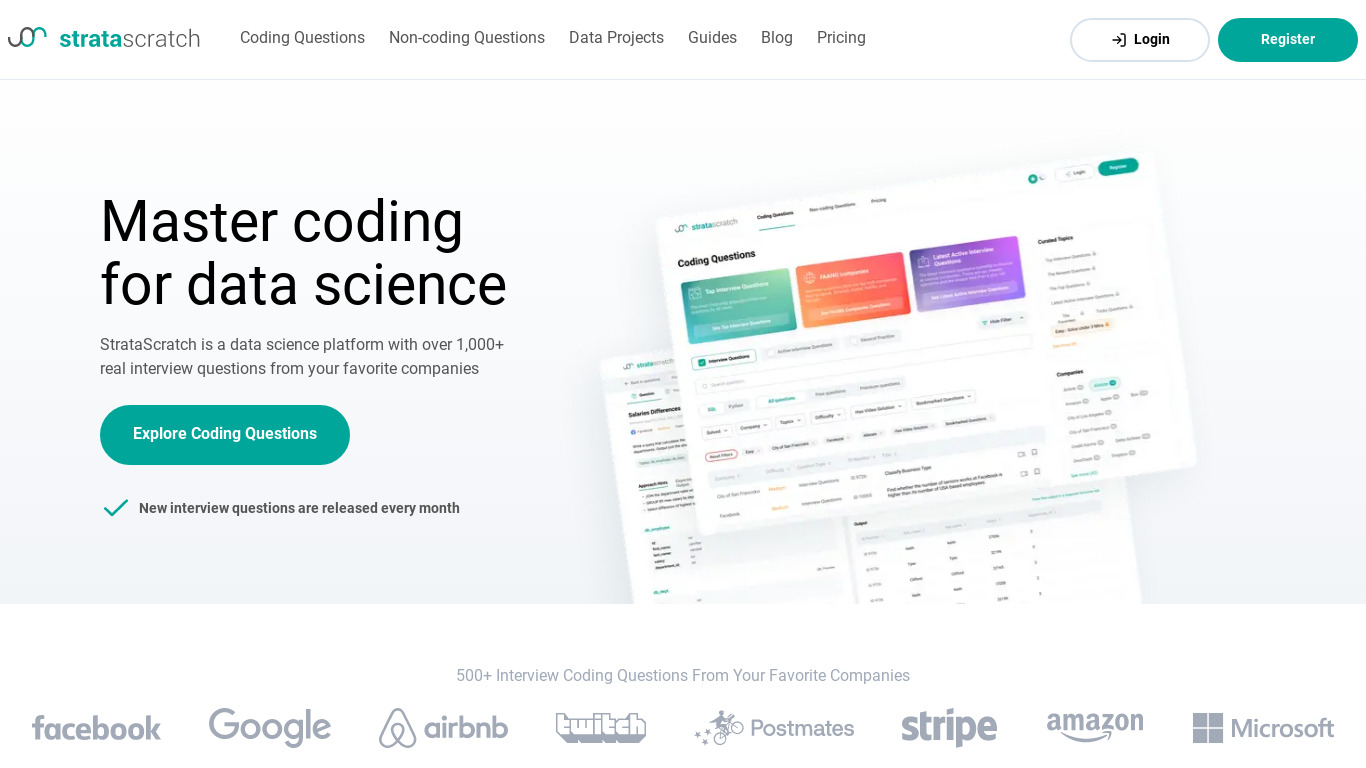
StrataScratch is a dedicated interview preparation platform built specifically for data professionals. We’re talking data scientists, data analysts, data engineers, and machine learning engineers — not software developers who occasionally run a GROUP BY query.
Founded by Nate Rosidi, the platform hosts over 1,000 real interview questions sourced directly from top tech companies including Facebook, Amazon, Google, Netflix, Microsoft, and Uber. These aren’t generic textbook problems — they’re actual questions that were asked in real interviews. That distinction matters more than you’d think.
The platform splits its content into three main pillars: coding questions (650+ problems you solve in a built-in Python or SQL environment), non-coding questions (400+ covering statistics, probability, system design, business cases, and product thinking), and data projects (51 end-to-end projects where you work with real datasets and popular libraries).

The Coding Experience: Where It Shines
Here’s the thing about coding interviews for data roles — they’re weird. Half the time you’re writing a window function in SQL, and the other half you’re implementing k-means clustering from scratch in Python. StrataScratch gets this. The platform supports multiple languages and technologies including PostgreSQL, Python, MySQL, R, MS SQL Server, PySpark, and Oracle.
The built-in coding environment is solid. Nothing flashy, but it works. You get a problem statement, a dataset to query or manipulate, and an editor to write your solution. Hit submit and you get immediate feedback. The test cases are reasonable — unlike some platforms where passing the hidden tests feels like guessing what the interviewer had for breakfast.
What I genuinely appreciate is the company-specific filter. Want to see only questions Amazon asks for data engineer roles? Done. Preparing for a Google data scientist loop? Filter and focus. This targeting alone saves hours that would otherwise be spent hunting through Glassdoor and Reddit threads trying to figure out what each company actually asks.
The video explanations are a newer addition and they’re well-executed. When you’re stuck on a problem, watching someone walk through their thought process is often more valuable than reading a static solution. That said, not every question has a video yet — they’re adding these progressively.
Beyond Coding: The Non-Technical Side
A lot of data science interview platforms treat the non-coding portion like an afterthought. StrataScratch doesn’t. The 400+ non-coding questions cover probability puzzles, business case scenarios, product thinking exercises, and system design problems — the exact kind of questions that trip people up in onsite interviews.
Think about it: you can be the best Python coder in the world and still bomb the “design a recommendation system for a streaming platform” question if you haven’t practiced structuring your thoughts. Having a dedicated space to work through these scenarios is genuinely useful.
The Data Projects: Portfolio Gold
This is my favourite part of the platform and the one that separates it from pure coding challenge sites. StrataScratch offers 51 data projects where you work with real datasets using libraries like BeautifulSoup, Folium, Gensim, Keras, LightGBM, and Matplotlib.
If you’re job hunting, completed projects are tangible proof you can do the work. A GitHub repo full of StrataScratch projects — especially ones that demonstrate skills with in-demand libraries — is going to catch a hiring manager’s eye far more than a generic “I’m passionate about data” cover letter.
The projects span a good range of complexity too. There are beginner-friendly ones for people just transitioning into the field, and more advanced ones that will challenge even experienced practitioners. I’d recommend doing at least 5-10 projects if you’re using the platform for interview prep — pick ones that align with the roles you’re targeting.
Pricing: What You Actually Get
StrataScratch operates on a freemium model. The free tier gives you access to all the non-coding questions and a selection of coding problems — enough to get a genuine feel for the platform before committing. For full access to the coding question bank, data projects, and video solutions, you’re looking at $139 per year.
There’s also a lifetime plan which, if you’re serious about a career in data science, works out to be the better deal over time. A single annual subscription gets you through one job search cycle, but the field moves fast and the questions evolve. Having permanent access means you can come back whenever you’re preparing for the next move.
Compared to alternatives like Interview Query or DataCamp, $139/year sits in the middle of the pack. But the real differentiator is those company-specific questions — platforms that don’t offer this are essentially asking you to prepare blind.
What’s the Trade-off?
StrataScratch isn’t perfect. The interface is functional rather than beautiful — it gets the job done but won’t win any design awards. If you’re someone who needs a polished, modern UI to stay motivated, you might find it a bit dated.
The free tier is genuinely limited. You can explore the platform and get a taste, but the real value — the coding question bank and data projects — sits behind the paywall. That’s not necessarily a criticism; they’re a business and the premium content costs money to produce and maintain. Just know that the free tier is more of an extended trial than a self-contained learning tool.
The other gap is social or peer-based features. There’s no built-in mock interview matching, no peer review system for project feedback, and the community features are minimal. If you thrive on collaborative learning, you’ll need to supplement with a study group or Discord community on the side.
Who Should Use StrataScratch?
If you’re actively interviewing for data scientist, data analyst, or data engineer roles at tech companies — especially the FAANG-tier ones — StrataScratch is one of the best investments you can make. The company-specific question filtering alone justifies the subscription cost when you’re targeting a particular employer.
If you’re a student or career-switcher who’s still building foundational skills, start with the free tier and pair it with a more structured learning path (Coursera, DataCamp, or a bootcamp). StrataScratch is interview prep, not a data science curriculum. It assumes you already know the fundamentals and need to practice applying them under interview conditions.
If you’re a software engineer interviewing for a data-heavy role, this is also worth your time. The SQL and Python problems will help bridge the gap between general-purpose coding and data-specific problem-solving. Just know that the pure algorithms content here is lighter than what you’d find on LeetCode.
🛒 Where to Get StrataScratch
Heads up: this is an affiliate link and I may earn a commission at no extra cost to you.
The Bottom Line
StrataScratch fills a genuine gap in the data science interview preparation landscape. It’s the closest thing the data world has to a dedicated LeetCode equivalent, and the company-specific filtering pushes it beyond what general-purpose coding platforms can offer.
Is it worth $139 a year? If you’re targeting a data role at a company that pays six figures, the ROI is obvious. One successful interview cycle — one offer you wouldn’t have gotten otherwise — pays for a lifetime subscription several thousand times over. The platform won’t do the work for you, but it gives you exactly the right problems to practice on. And in interview prep, that’s most of the battle.
Check out StrataScratch and start practicing with real interview questions →